

Code Brown
Wow, what a week. With the US election result, and now big earthquakes and wild weather in New Zealand, I thought we could do with a little comic relief. Today we'll investigate my favourite piece of communication of recent times. I hope it will make you laugh as much as I did.

Code Brown
Wow, what a week. With the US election result, and now big earthquakes and wild weather in New Zealand, I thought we could do with a little comic relief. Today we'll investigate my favourite piece of communication of recent times. I hope it will make you laugh as much as I did.
Do you remember the infamous Invercargill "poo pooper" of 2015? In case you're memory escapes you, during February and March last year, poos were found floating in Invercargill's Splash Palace swimming pools on six consecutive Friday evenings.
Council staff estimated that the cost of closing and cleaning the pool and lost revenue was upwards of ten thousand dollars. I can only imagine the pool was probably getting pretty empty on Friday nights by the end of March. While it's tempting to giggle at stories like this, Wellington City Council has designed a poster to remind us that it's not a laughing matter.

While pooing in the pool might not be funny, the poster certainly is. Rather than lecture the public about the dangers of fecal contamination, the council has decided to take a more low-brow approach. This works. It grabs your attention, tells you what you need to know about the problem and offers potential solutions — all in under five sentences.
Interestingly, the poster never actually says "don't poo in the pool". Attention-grabbing synonyms are used as a stand-in for instructions. They manage to elicit a laugh and aren't so obscure that the reader needs to consult urban dictionary. For anyone unsure of any of these phrases, the large brown splodge drifting down the page will surely help with the translation.
I've seen this poster a bunch of times and it makes me laugh every time. Especially when it's projected onto the really huge screen behind the main pool. They say laughter is the best medicine, and I've found it pretty soothing in this poo-nami of a week.

-AP

XY Combinator
Because I aspire to a life of Sysiphisian scrambling and hate free time, I recently renewed my long-lapsed New Yorker subscription. Before becoming buried under a stack of thin volumes and a feeling of general ennui, I devoured—with equal parts prurient interest and visceral horror—Tad Friend’s October 10 profile of Sam Altman and Y Combinator, the famous Silicon Valley start-up incubator.

XY Combinator
Because I aspire to a life of Sysiphisian scrambling and hate free time, I recently renewed my long-lapsed New Yorker subscription. Before becoming buried under a stack of thin volumes and a feeling of general ennui, I devoured—with equal parts prurient interest and visceral horror—Tad Friend’s October 10 profile of Sam Altman and Y Combinator, the famous Silicon Valley start-up incubator.
The profile reads a bit like an Old Testament genealogy, with a cavalcade of highly educated men parading across the pages in account after account of male excellence and folly. It’s no secret that Silicon Valley is governed by men (white men, specifically), but surely there would be some women entrepreneurs or backroom VCs that would warrant a mention in the 12 dense pages? Yeah? …Nah. Grab the feminist pitchforks!
I thought I'd get a bit of data behind me before publicly venting my righteous anger, so I went back to the magazine for a deeper look.
My first impulse when looking at a text is not usually to dive into a quantitative analysis. This goes back to my time as a gormless undergraduate, when I was happy (and lucky) to fall under the influence of a cabal of Marxist media theory lecturers who wore black and drank a lot of diet coke. In contrast, the few old-fashioned social scientists in the department were referred to derisively as “television counters” — stodgy and overly concerned with viewer counts and user surveys. But in a political climate where gut feelings are lauded as fact and facts are political, a bit of good old fashioned television counting can be a useful counterbalance. Time for a close reading.
I drew up a quick table for tracking the numbers of men and women mentioned in the story. Upon beginning the count, I soon needed to add a third column for an ambiguous category of "personhood": artificial intelligence (AI). Here’s what I found:
NAMED CHARACTERS
Men: 59
Women: 7
AI: 3
Digging in a little bit, I parsed out the numbers of active characters—those interviewed or discussed at any length—from the names that were referenced once or mentioned only in passing. Here’s how that breakdown looks:
CHARACTERS INTERVIEWED OR DISCUSSED AT LENGTH
Men: 40
Women: 3
AI: 0
There we go. Once you take out breezy cultural namedrops (“Hillary” “Beyoncé”) and references to robot assistants, you’re left with three women who play an actual role in the story.
These three women are all defined by their relationship to protagonist men: Sam Altman’s mother, his high school counselor, and his colleague’s wife-slash-business partner. Friend initially introduces Altman’s mother and his colleague’s wife not by name, but as “his mother” and “his wife” respectively. Of the three, Jessica Livingston, wife of Paul Graham and co-founder of Y Combinator, is discussed at the greatest length. In contrast to her husband and the other founders whose technical skills and theories about machine learning are covered in depth, Friend lauds Livingston for being a “remarkable judge of character” who gives "advice and home-cooked chicken fricassee” to young entrepreneurs. Livingston has a noteworthy career as a marketing VP, founder, and investor outside of her work with her husband, but it’s her tasty chicken that seems to have made the most impact—at least on the author.
And the AI column? Each of the of anthropomorphized AI systems—Apple’s Siri, Amazon’s Alexa, and Microsoft’s Cortina—are gendered female, although I would hesitate to place them in the "women" column alongside Beyoncé, Hillary, and Altman’s mom. It is worth noting that similar to the three women interviewed in the story, the feminized AI all function as service and support providers, assisting without complaint.
We all know that tech has a “women problem” (not to mention a “diversity problem” in general). Is it really so bad though, that a journalist would encounter only one woman whose contribution to the milieu is worth writing about? While representation isn’t the same as true inclusion, I’d hope that the New Yorker considers the balance of gender, race, class, and etc within and across its weekly feature stories.*
Outside of supportive wives and mothers, there is one fleeting mention of the existence of female entrepreneurs. Friend is reporting from a Y Combinator party, and he notes that “all the early arrivals at the party were men; the batch’s female founders were attending a presentation on the challenges of being a female founder”.
Yeah.
Did the women entrepreneurs turn up later to talk shop and complain about patriarchy around the fire pit? Friend doesn’t say. Maybe he didn’t stick around to find out.
---
*The other feature articles in this issue were “The Anti-Uber: A new strategy in the ride wars”, “Cashing Out: Do we need paper money?”, and “Trump town: How a West Virginia county turned deep red”. While I’m not masochistic enough to analyze the whole magazine, suffice to say it was not a very woman-heavy issue.
-KP

💩 is the new black
Last week, the Museum of Modern art announced it has added the first ever set of emoji to its permanent collection. These 176 icons were released by Japanese cellular provider DoCoMo way back in 1999. While some people have happily peppered their text messages with a multitude of colourful icons for close to two decades, I stuck to using boring old words until very recently.

💩 is the new black
Last week, the Museum of Modern Art announced it has added the first ever set of emoji to its permanent collection. These 176 icons were released by Japanese cellular provider DoCoMo way back in 1999. While some people have happily peppered their text messages with a multitude of colourful icons for close to two decades, I stuck to using boring old words until very recently. I've turned over a new leaf of late, only a few years behind my mum. To celebrate my transition to the world of emoji and MoMA's acquisition of their pixelated predecessors, today's blog post brings you three short stories about these cultural phenomena:
One step ahead
Anyone who's got an iPhone will know that Apple has recently introduced a predictive emoji function, which lets you replace words with a corresponding image. You can either replace as you go, or check your whole message for possible substitutions once you're ready to send. This tool is handy as a sort of emoji search engine — if you know what you're looking for, it can save you swiping through seemingly endless screens of pictures. Personally, I'm not so sold on the benefits of replacing words in sentences with pictures as a matter of course.
We see many icons on a daily basis that have standardised meanings which transcend linguistic and national boundaries, such as traffic signs. However, the meaning of emoji aren't fixed — their usage varies from place to place and they can be used as either a literal representation of something or to add meaning or emotional context. I'm pretty sure 🍆 isn't such a popular emoji because everyone's captioning photos of vegetarian moussaka. Because of this fluidity, in many cases using emoji to replace words makes communication messier rather than more concise. I guess if Pictionary without the actual drawing is your dream game, then predictive emoji might be your new best friend.
Behind the curtain
How can you be sure that when you're sending 😎 to a friend with a different phone, you're not actually sending 💀? When you send an emoji, the picture isn't being transmitted from one device to another. Instead, each emoji has a corresponding code which tells the receiving device which image to show (e.g. U+1F61C = 😜). There are close to 2000 standardised codes which are used by all the big providers including Apple, Google, Facebook, and Windows.
Since 2009, emoji have been incorporated into Unicode, a widely used standard for the consistent encoding and representation of digital characters. The addition of emoji to the standard has allowed them to be consistent, and therefore easily sent between different platforms and devices. New emoji are added each year, and anyone can submit a proposal for one to be considered by the Unicode Emoji Subcommittee. Wouldn't membership of this group be a great addition to your CV?
Even with standardised codes, there have been miscommunication horror stories due to inconsistent emoji design across platforms. A remedy to this came in 2015 when Unicode published it's creatively titled Technical Report #51 which includes design guidelines for improving interoperability across platforms. Here's a few key pointers we learned from the report:

Image by Antistatic, using emoji from emojione
Even with these guidelines, some emoji vary quite a bit between platforms. If in doubt, you can check out this table to see what you're actually sending a friend with a different phone.
Predicting the future for emoji
When new methods of communication enter the popular imagination, they are often accompanied by impassioned cries from concerned folks who worry about the denigration of language. Emoji are no exception.
The jury is still out on what will be next for emoji — they could cement themselves as a key component of communication in the digital realm or become little more than a fleeting technological curiosity to explain to future generations (have you ever tried to explain fax machines to a 12 year old?).
I thought it could be fun to use the past as an indicator of a possible future for emoji, so I digitally delved into some old newspapers to find out what people thought about the use of slang 100 years or so ago. While slang and emoji are quite different beasts, they both represent an incremental change in the way we communicate. Here are a couple of my favourite slang-related snippets — I suggest mentally replacing the word 'slang' with 'emoji' for full future-gazing effect.

From the Otago Daily Times, 12 December 1924 From the Evening Star, 31 August 1907
Both excerpts are from the National Library of New Zealand's Papers Past website
-AP
BLTs, Moms Everywhere, New York City
Let’s watch a video. It’s not new, but it’s still worthy of comment. This video, titled Bits and Atoms was released to accompany Uber’s new logo and "brand experience” in February 2016. As of October 2016, it has under 49,000 views on Youtube so it’s hard to say who the intended audience was. It’s a deeply weird video. Let’s take a look:

BLTs, Moms Everywhere, New York City
Let’s watch a video. It’s not new, but it’s still worthy of comment. This video, titled Bits and Atoms was released to accompany Uber’s new logo and "brand experience” in February 2016. As of October 2016, it has under 49,000 views on Youtube so it’s hard to say who the intended audience was. It’s a deeply weird video. Let’s take a look:
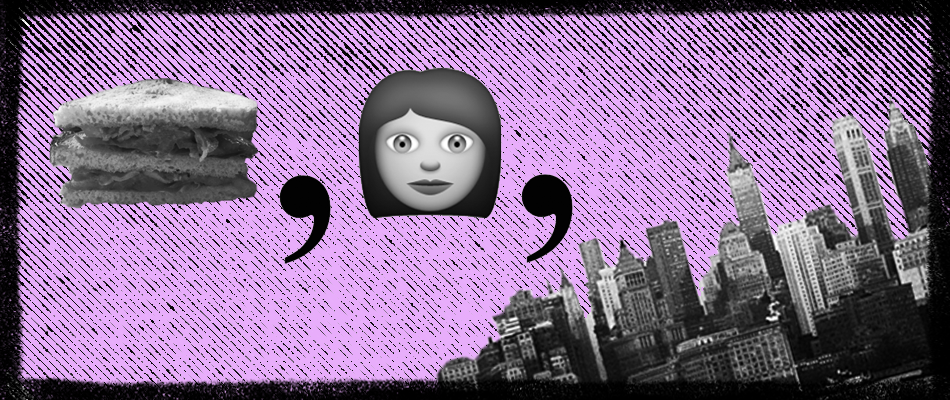
As a premise, the entire “bits and atoms” concept is a bit creaky, but what I want to focus on specifically is the video's list of things for which the atom is responsible: “from the BLT, to moms everywhere, to New York City." This fanciful litany is meant to hint at the unfathomable breadth of stuff comprised of atoms (as if we needed reminding?) but as a list, it sucks.
The BLT, moms, NYC list isn’t the first list in this video — it’s the fourth. The earlier lists are nothing out of the ordinary, describing the ways the bit has changed the world; what this represents for Uber; and some characteristics of the bit as expressed in code. These lists are conventional in that their items belong to the same class or category. Across genres, lists tend to keep like with like, whether it’s a cover letter (“my skills include filing, stapling, and MS Paint”) or dating profile (“I like hiking, laughing, and burritos”). With “the BLT, to moms everywhere, to NYC” we’re faced with a needle-scratch list that shows an audacious disregard for categories.
There is a grand history of absurdist lists, where an organizing principle is introduced then subverted for humorous or sublime effect. In Jorge Luis Borges' essay The Analytical Language of John Wilkins, he writes of a “certain Chinese encyclopedia” that divides animals into fourteen categories:
(a) belonging to the emperor, (b) embalmed, (c) tame, (d) sucking pigs, (e) sirens, (f) fabulous, (g) stray dogs, (h) included in the present classification, (i) frenzied, (j) innumerable, (k) drawn with a very fine camelhair brush, (l) et cetera, (m) having just broken the water pitcher, (n) that from a long way off look like flies.
Well, that escalated quickly. By setting up unusual but acceptable encyclopedic categories like “embalmed” and “tame” then swerving to the abstract (“innumerable”) and the imaginary (“drawn with a very fine camelhair brush”) the list creates a pleasing frisson and a great gag on the nature of classification. Foucault went on to borrow this list as an inspiration for his book The Order of Things, an investigation into modern forms of knowledge.
So the disorderly list has a noble precedent. And the BLT, moms, NYC list is disorderly, certainly: jumping hither and yon from a type of sandwich (BLT) to a category of personhood (moms everywhere) to New York City (a built environment and its inhabitants). Each list item is conceptually and categorically distinct, and each has a specific intended emotional impact. BLT: comforting! classic! American! delicious! Moms everywhere: we all have moms! aw! where would we be without them! New York City: dynamic! cosmopolitan! center of culture and industry! And all of it made from atoms. Wow, atoms are exciting. But without an implied rule set up at the beginning of the list (“this is a list about types of animals!"), we’re left without a point of departure. Why should I care about the crazy leap from sandwiches to moms?
The failure to cohere may be intentional, showing off the all-encompassingness of the atom, but as a rhetorical device it lacks punch. It’s sloppy. The thing that makes the list ineffective is the same thing that makes the entire video inane — it speaks in such broad strokes that it becomes meaningless.
A cynical viewer, however, might assume that Uber are happy to abandon the chance for rhetorical finesse in order to collect a grab bag of nice things they want to be associated with. When you’re aiming for global market domination and preparing to abandon your contingent labor force for driverless cars, perhaps it makes sense to try and get your audience on side with some feel-good word salad.
Repeat after me: BLTs! Moms everywhere! NYC!
I'm feeling better already.
-KP