

My takeaways from NetHui on Copyright
I attended Internet New Zealand’s one-day NetHui on Copyright at Te Papa today. This event featured great speakers, robust discussion and very delicious catering.

My takeaways from NetHui on Copyright
I attended Internet New Zealand’s one-day NetHui on Copyright at Te Papa today. This event featured great speakers, robust discussion and very delicious catering.
I’m not a copyright expert, so perhaps unsurprisingly, many of my key takeaways from this event weren’t directly about New Zealand’s copyright law. In fact, my internal monologue often wanted to yell “smash capitalism” as a (potentially not-so-helpful) suggestion to fixing many of the issues that need to be addressed.
At its heart, copyright law would ideally enable and value creativity and innovation, and ensure that consumers and citizens have access to a range of content and voices.
To that end, I have cobbled together six principles that I think could go a long way towards realising these values. Most of these principles were gleaned from the speakers and conversations at NetHui. I imagine that as I learn more about copyright and let what I learned today percolate further, my views on these principles may indeed change!
COPYRIGHT IN A DIGITAL WORLD: SIX BROAD PRINCIPLES
If you make access to content easy, universal (e.g. multiple platforms and countries simultaneously) and reasonably priced, it’s less likely people will pirate your content.¹ This goes for both accessing content for personal use, and for those who want to copy or use part of a work to create something new.
Creators should be the primary beneficiaries from the work they create, followed by investors and distributors.² The cut that each party gets should be in proportion to the contribution they make to the product.
In order to facilitate open discussion, criticism and debate, there should be some circumstances in which parts of creative works can be used without getting prior permission from the rights holder. This could include satire, parody, or making a documentary that may not paint the subject in a good light.
Work that is publicly funded should be available to benefit the public good. This includes content produced by the government and publicly funded academic research. Although potentially more tricky, it could also include creative content funded through NZ on Air and other public funding bodies.
Copyright is inextricably linked into all sorts of different issues, so just fixing one piece of legislation is unlikely to make a big difference. If we work out what we want to achieve as a society, then work out what we need to do to get there, it’s more likely we can get lasting change.³
Once you have purchased a product, it should be your right to choose how to get it repaired, what software you use on it, and what data to provide the company about your use of the product.
- - -
¹ While this was discussed widely at NetHui, it’s also been talked about a lot by Mark Kermode recently on his weekly podcast with Simon Mayo (in relation to film).
² This idea was gleaned from Cory Doctorow’s keynote speech.
³ Pia Andrews discussed this idea in the afternoon panel session.
-AP

What’s in a name: Ministerial edition
I recently sent an Official Information Act request to the Department of Prime Minister and Cabinet (DPMC) hoping to get to the bottom of one of the great mysteries of political semantics: what’s with the inconsistent naming of Ministerial portfolios? How come we have a Minister of Conservation but a Minister for the Environment? I recently received a letter from Michael Webster, Secretary of the Cabinet, with the answer I’d been waiting for.

What’s in a name: Ministerial edition
I recently sent an Official Information Act request to the Department of Prime Minister and Cabinet (DPMC) hoping to get to the bottom of one of the great mysteries of political semantics: what’s with the inconsistent naming of Ministerial portfolios? How come we have a Minister of Conservation but a Minister for the Environment? I recently received a letter from Michael Webster, Secretary of the Cabinet, with the answer I’d been waiting for. Here’s the scoop:
If you’re like me and spend too much time looking at the official Ministerial lists, you’ll see that the portfolio titles include a grab-bag of conjunctions. “Of” and “for” are used seemingly interchangeably, with the odd “responsible for” thrown in for good measure:
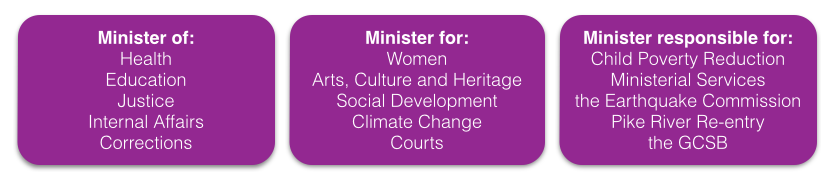
Examples of Ministerial portfolio titles following the 2017 General Election
“Minister Responsible for” roles are usually listed as “other duties” on the Ministerial list. These roles aren’t official portfolios as such, and appointments are made by letter from the Prime Minister. Ministerial portfolios, on the other hand, are appointed through a warrant, which is an official document signed by the Governor-General. When it comes to picking what roles get the “Minister responsible for” designation, Mr Webster says “Sometimes they are less significant in size and content than warranted portfolio positions. In other cases, though, Prime Ministers have used the titles… to signal that certain Ministers have overarching sectoral policy and delivery coordination roles, across a number of portfolios.”
The difference between a Minister “of” and a Minister “for” titles are the product of tradition and the Prime Minister’s preference: “Usually, when new appointments are made to established portfolios, the portfolio titles remain the same, especially if the title is used in legislation. Sometimes, of course, the Prime Minister decides to change the title, for example, to reflect a particular priority.”
In the new Government, there a number of portfolios with an amended title (in addition to some brand new ones). Some changes were the result of extra responsibilities in a role or a change in focus. An example is the Minister of Trade, which is now the Minister of Trade and Export Growth, which is no surprise seeing as export growth is a priority for New Zealand First.
Another change is the move from “Minister of Veteran’s Affairs” to “Minister for Veterans”. This is part of a trend to move away from titles with “Affairs” at the end. The Ministers for Ethnic Communities, Women, Pacific Peoples, and Māori Development all have portfolios that have dropped the “Affairs” in the last few years.
Mr Webster also pointed out that portfolios which have been around for ages (think Health, Education, Finance, Justice), are more likely to have an “of” prefix, and newer titles will have a “for”. “Of” is also often used when a portfolio directly relates to a Ministry or Department (once again, Health, Education, Customs and Statistics all are “of” and are supported by Ministries/Departments of the same name).
So there you have it. While I was hoping to uncover some thrilling and complex Ministerial naming system dating back decades, there’s not really a whole lot of rhyme or reason to the whole thing, just the PM following tradition and making the occasional bold statement to mix it up.
-AP

Political Mongrels
New Zealand politicians are a real pack of mongrels. Or at least, that’s what they’d like you to think. In any other country’s political context, the press congratulating an ascendant politician on having “a mongrel streak” or a party leader describing his communications director “a mongrel, like me” would be seen as bizarre, crass, and probably racist. In New Zealand, by contrast, “mongrelism” is celebrated in politicians and sports stars alike. But… why? And: what’s wrong with us?

Political Mongrels
New Zealand politicians are a real pack of mongrels. Or at least, that’s what they’d like you to think. In any other country’s political context, the press congratulating an ascendant politician on having “a mongrel streak” or a party leader describing his communications director “a mongrel, like me” would be seen as bizarre, crass, and probably racist. In New Zealand, by contrast, “mongrelism” is celebrated in politicians and sports stars alike. But… why? And: what’s wrong with us?
Originally a vernacular term for a mixed breed dog, a mongrel was an accidental cross breed, a mutt of dubious provenance with a likely feral streak. In a short leap of racist logic, “mongrel” has historically also been used as an offensive term meaning “a person of mixed race", with connotations of coarseness, vulgarity, and ugliness.
In New Zealand, of course, the term is synonymous with the Mongrel Mob street gang. According to Mob mythology, the name first came about as an insult hurled at young troublemakers by law enforcement. “Mongrel” became a point of pride as the gang solidified, signifying gang members’ wild and lawless behavior. The Mongrel Mob name stuck as gang membership became predominantly Māori and Polynesian, now doubly resonant as a reclamation of a racial slur and a retort to polite society. “Mongrel” retains its weight as an insult to this day, with violent criminals and heartless landlords alike tarred as irredeemable “mongrels” in the national media.
More recently, “mongrel” has also emerged as an admiring term for someone reckless and headstrong, with “a mongrel streak” or “a bit of mongrel” considered a necessary characteristic for a cutthroat politician or a rugby player. To be “a bit of a mongrel” is to be unpredictable, dogged, pugnacious, and hard charging. What could be more New Zealand than that?
Here’s where it gets a bit tricky. Take a look at who gets to access the positive “mongrel” identity without fear of criminalisation or critique. It's white men, mostly. Māori and Pacific Islanders get to be mongrels on the sports field, where “mongrelism” slots in with other racalised traits like physical prowess and imperviousness to pain. Off the field, though, “mongrel” traits in Māori and people of color are usually tied to criminality—and not only because of the literal association with the Mongrel Mob—or less-than-humanness. And while some women in politics are lauded for their "mongrel streaks”, you can bet that those same women are more often accused of being hardarses, bitches, and ball busters. More common are cases like the recent NZ Herald and Stuff.co.nz news stories where a politician like Jacinda Ardern is judged over her perceived lack of mongrel. This deficit is synonymous with other charges that often plague women in leadership—being insufficiently tough, too emotional, or too weak to face fierce opposition.
So when Gareth Morgan applauds Sean Plunket for being “a mongrel, like me”, he’s tapping into a whole set of characteristics that are applauded in white men and criticized in anyone else. He’s a bit of a mongrel, while you’re a bitch or a thug.
Am I stretching the case here? Sure, maybe. Most good Kiwis would tell you that there’s no racial or gendered undertone to calling someone a mongrel in 2017. Then again, those same folks are the ones most likely to complain about “PC gone mad” when they hear that McDonalds might start allowing boys to choose a Frozen toy instead of a Transformer with their happy meal.
New Zealanders are often guilty of holding on to habits and turns of phrase that are well past their use by date, with proud dismissal of changing social standards. I get the appeal of mongrelism: it fits with the idea of the tenacious Kiwi battler, an underdog winning out despite the odds. But that shit gets old. I’d like to see us own up to the gendered, racially loaded connotations of "mongrelism" and find a new way to talk about our grit, our perseverance, and our strength of spirit.
-KP

Love, actually???
I was recently drawn in by a link on the New Zealand Herald website that boldly proclaimed "NZ's favourite rom-com has been found" (spoiler alert, it's Love, Actually).

Love, actually???
I was recently drawn in by a link on the New Zealand Herald website that boldly proclaimed "NZ's favourite rom-com has been found" (spoiler alert, it's Love, Actually).
As a not-so-secret fan of rom-coms and frivolous online listicles, I clicked through to find out more. After a short blurb, the article heads straight into three lists: New Zealand's all-time favourite rom-coms; New Zealand's favourite romantic hero; and New Zealand's favourite romantic heroine. Being fairly sure the data to back these bold assertions didn't come from the last Census, I had a closer read to find out where this insight came from.
Turns out the data was from a survey of 200 Elite Singles members, the majority of whom are "educated, relatively affluent, and between the ages of 30 and 55". While using a sample group in order to gauge the make-up of a wider population is a common statistical method, in order to get an representative result, the sample group should be picked at random from the wider population. While I'm no statistician, I'm pretty sure a small group of single, middle class people aged 30-55 with a university degree isn't representative of all New Zealanders.
The use of such an unrepresentative sample means that Love, Actually may well not be New Zealand's favourite rom-com. While it's of little-to-no consequence if Hugh Grant isn't actually New Zealand's favourite romantic hero, there are times where the collection of, and reporting on, data does have real life consequences — like a general election. In saying that, there are guidelines in place for conducting general election polling in New Zealand, as well as guidance for media reporting on the polls. Hopefully this means while we will never know for sure our favourite collective rom-com, the New Zealand Herald won't be predicting our next Prime Minister based on the views of a couple of hundred people looking for love.
Using data to back up arguments and inform decisions is a really good thing. It's just important to remember that there are usually multiple steps in between the collection of data and the end result, whether it's a policy decision or a showbiz listicle. This process is likely to get more complex and less easy to interrogate as more and more decisions are made from huge quantities of data. It's important that data journalists and other people using data to present arguments know how to interpret and present it truthfully.
On that note, I suggest this article is re-titled "Single, middle class people in New Zealand quite like Love, Actually".
-AP